
Karl Plattner
Riflessi dell'animo | Spiegelbilder der Seele
01.16.2027
Thursday 12 November, 6.00 pm
Introduction by Eva Gratl
Karl Plattner’s daughter will be present
Forty years after his death in Milan on 8 December 1986, Karl Plattner (Malles Venosta, 1919 – Milan, 1986) remains the most significant figure in South Tyrolean figurative art of the second half of the twentieth century. Over a life spent between Florence, Paris, Brazil and finally Milan, Plattner developed a highly personal and instantly recognisable pictorial language, poised between a post-Cubist sensibility and echoes of Central European Expressionism.
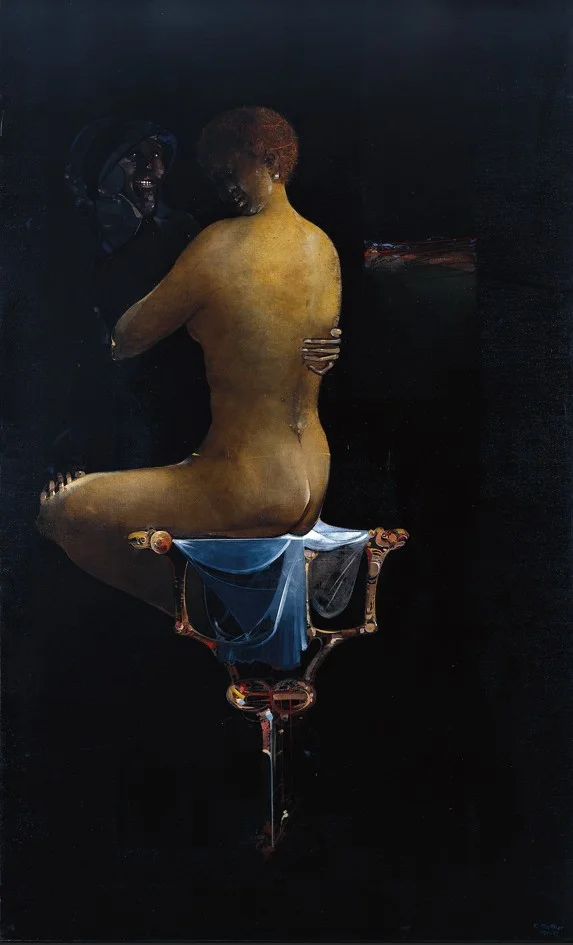
In her critical reading of Plattner’s work, the art historian Gabriella Belli observed that time, in this painting, never translates into chronological evidence: forms and themes return with stubborn constancy, in a circularity that resembles a recurring existential urgency more than a linear development. His canvases emerge from a slow process of sedimentation (weeks, months, sometimes years) during which the painted ground, worked and then long set aside, finally allows the figure to surface almost as a revelation. On this ground, according to Belli, there is an interplay between a real space, entrusted to the detail of bodies and objects, and a psychic, symbolic space, suggested by the artifices of colour.
Within this pursuit, the female figure has always held an absolutely central role, running uninterrupted through the entire span of his work. Among its forms, the figure of the mother holds a special place, at once universal and deeply autobiographical. Widowed at a young age, Plattner’s mother raised him and all his siblings on her own, holding the family together in far from easy circumstances. It was she who, with her own determination, recognised the young Karl’s artistic vocation and supported it resolutely, at a time when such a choice could hardly be taken for granted. It is no surprise, then, that the theme of the woman as mother returns again and again, in different forms, in the artist’s work, each time rekindling the memory of that beloved presence.
The other great pole of the feminine in Plattner belongs to the same psychic space: the more unsettling one of Eros and Thanatos, in which the female body takes on an ambiguity that is both seductive and deadly. For Plattner, then, the feminine is from the very beginning a twofold experience. It is a force capable of bearing the weight of life and opening up a horizon, but also a presence that carries with it the shadow of desire and of the end. It is a legacy his painting never ceased to question, decade after decade.
What remains striking today, above all, is the absolute timelessness of this painting. The themes Plattner addresses belong not only to the society in which the artist was formed: the body, female identity, the passing of time, the fragility and strength that coexist at every stage of life. They speak with the same urgency to today’s audiences, because they do not describe an era, but a human condition that is renewed, essentially unchanged, with every generation. This relevance of content goes hand in hand with an utterly original and immediately recognisable painterly style. It rests on construction through backgrounds and overlapping planes, on a line that both carves out and reveals the figure, and on an ever finely calibrated balance between matter and psychic space. It is a stylistic signature that cannot be mistaken for that of any other painter, whether among his contemporaries or among today’s artists, and one that Plattner kept consistent for more than thirty years without ever hardening into mannerism.
Galleria Alessandro Casciaro in Bolzano pays tribute to him by choosing a single guiding thread to trace his entire artistic trajectory: the female figure, explored with a constancy that spans twenty years of work, from 1964 to 1984. In the exhibition, this unfolds as a true cycle of the ages of life through 11 works selected from various private collections. Arranged across the gallery’s two rooms, the exhibition follows neither a chronological order nor a strict sequence by age. Instead, the pairings are designed to bring different periods and tones into dialogue, in a construction of contrasts and resonances that is itself part of the narrative.
The exhibition is therefore not conceived as a retrospective, but as a critical journey that can also speak to those encountering Plattner for the first time. It invites the visitor to read an entire artistic life through the most human and universal theme that runs through it: time, which transforms bodies and gazes. Forty years after his death, Karl Plattner thus returns to public attention with the power of an artist who was, in his lifetime, among the most authoritative figures in Italian art after the Second World War, and who, decades later, has lost none of his capacity to question the viewer.
Related Artists
Keep me updated
Subscribe to our monthly newsletter with all the exhibitions, artist highlights and special events