
Domenico Grenci
Ciò che resta
01.30.2027
Alessandro Casciaro Venice
Opening: Saturday, November 14, 5-8 pm
Ciò che resta (What remains) emerges from an absence. The female figure, protagonist of much of Domenico Grenci’s (Italy, 1981) painting, disappears from the canvas. Only traces remain: a fold, a shadow, a fabric, a floral motif. The body is no longer depicted, yet seems to persist in the material that once enveloped it.
This new body of work, created by Domenico Grenci and presented for the first time at the gallery, stems from his encounter with Venice and its long-standing textile tradition. Grenci undertakes a historical and philological investigation, ranging from eighteenthcentury patterns to the Art Nouveau geometries of Mariano Fortuny, and extending to textile details drawn from the city’s vast pictorial iconography, from Giovanni Bellini to Titian. Fabric thus becomes both image and archive: its decorations preserve the memory of bodies, interiors and gestures that are no longer present. In Grenci’s paintings, damask patterns are enlarged, fragmented and layered until they lose their original function. Fabric ceases to be a merely decorative surface and becomes an autonomous pictorial space, where recognisable forms coexist with abstraction.
It is precisely this possibility of evoking a presence through its absence that brings Grenci’s research into dialogue with tagasode, a traditional theme in Japanese painting whose name literally means “whose sleeves are these?”. In tagasode paintings, sumptuous kimonos are depicted without the people who wear them: garments thus become true portraits without faces, leaving viewers to imagine the body and the story to which they belong.
The disappearance of female features represents more than an iconographic shift; it calls into question the relationship between body, identity, fabric and representation. Where the face once served as the locus of presence, fabric now becomes the bearer of memory. The female figure is not erased, but brought back into view through what remains.
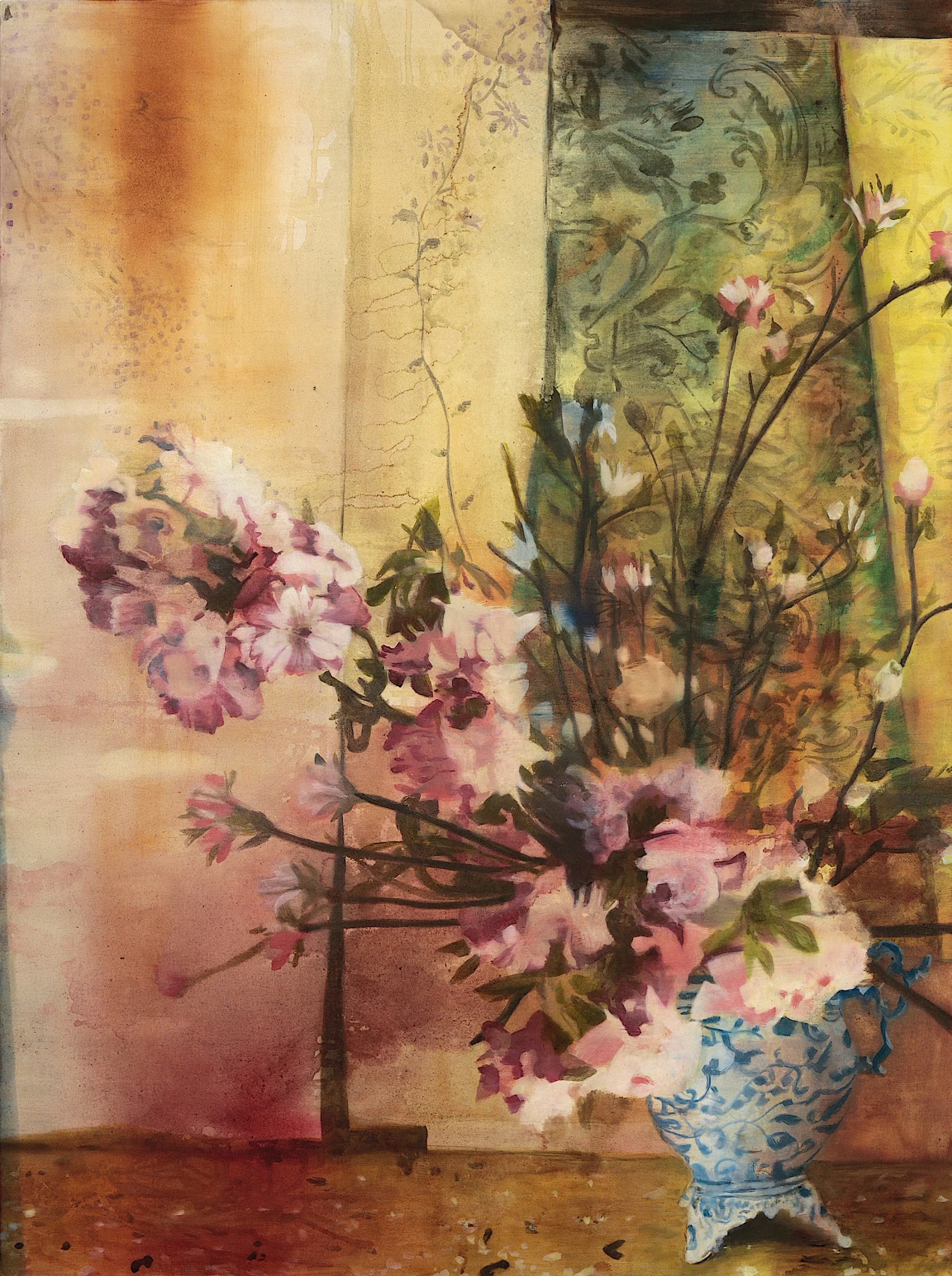
In Sulla via dei fiori 6, the large diptych at the heart of the exhibition, this transformation takes on an almost scenographic dimension. A floral composition runs across the two painted surfaces, emerging from an interplay of ornamental patterns, transparencies and traces of historical textiles. The vase and flowers, recurring elements in the artist’s practice, seem to surface from a ground that is at once wall, fabric and memory.
In works on paper, such as Sulla via dei fiori 8, this dimension takes on a more tangible form. The support retains the appearance of a fragment of antique wallpaper, as though it had been torn from the walls of a ruined Venetian palazzo. On this surface, a historically derived damask pattern accommodates the delicate presence of flowers, transforming the paper into an architectural fragment: a surface that has survived the disappearance of the place from which it originated.
The painterly gesture also undergoes a transformation. In contrast to his previous practice, based on the use of charcoal and bitumen, Grenci here turns to a denser form of painting, built up through oil and acrylic. The material accumulates in layers, while detail gradually loses its descriptive function: a fold in the fabric can become a landscape, a shadow, a figure, an ornamental motif, an almost abstract surface. In this new series, Venice is not merely the place where the works are presented, but a visual and emotional repertoire through which Grenci questions his own artistic language.
Fabric, like painting, reveals itself as a device that both preserves and conceals. And the question remains open: whose sleeves are these?
Whose is the body we cannot see? What story belongs to these surfaces? And how much of a person can survive in the patterns, folds and images they have left behind?
Related Artists
Keep me updated
Subscribe to our monthly newsletter with all the exhibitions, artist highlights and special events